%201-1.avif)
Ultrahuman Ring Pro vs Circular Ring 2: Which is worth buying?
The Ultrahuman Ring Pro is one of the most anticipated smart ring releases of the year. When it was first announced, the 15-day battery claim put it immediately on my radar and next in line for my Side by Side series. But with shipping still two months away, I couldn't help but do what any impatient tech reviewer would. So I went deep on the specs anyway.
And yes, I compared it with my Circular Ring 2 that’s been with me for the better part of the year now. Ahead, I’ll break down the 5 major differences between the Ultrahuman Ring Pro vs Circular Ring 2, including AI coaching, battery life, and pricing, so you can have a clear picture of what each ring brings to the table before you decide if that pre-order is worth it.
Core Specs and Features Comparison
| Circular Ring 2 | Ultrahuman Ring Pro | |
|---|---|---|
| Price | $349 – $549 (price varies by color) | Presale: $479 Retail price: $530 |
| Subscription | No subscription for the 13+ core features (including ECG & AFib detection) | Monthly paid add-ons: Cycle & Ovulation Pro ($3.99); AFib detection ($4.99) via PPG sensor; Cardio Adaptability ($2.90) |
| BUILD & DESIGN | ||
| Outer shell material | Titanium with PVD coating (gold, rose gold finishes) | Unibody titanium + PVD coating + epoxy + polycarbonate |
| Inner surface | Hypoallergenic interior (non-metallic) | Hypoallergenic plastic + titanium inner layer |
| Weight | ~2–3g | 3.3–4.8g |
| Band thickness | 2.55mm | 2.65mm |
| Water resistance | Fully Waterproof | Fully Waterproof |
| BATTERY & CHARGING | ||
| Battery life (daily use mode) | Up to 7 days in Power Mode Up to 5 days in Performance Mode |
Up to 15 days (2× longer) Up to 12 days in Turbo Mode |
| Charge time (ring only) | 30 minutes for full charge | 180 minutes |
| Case Find My feature | No | Yes (in-app proximity tracking) |
| SENSORS & HARDWARE | ||
| ECG sensor | Yes (Exclusive) + exportable PDF | No |
| Temperature; PPG; SpO2 sensors | Yes | Yes |
| Motion sensor (IMU) | 3-axis accelerometer | 6-axis IMU (accelerometer + gyroscope) |
| HEALTH FEATURES: SLEEP & FITNESS | ||
| Sleep stages, duration, latency; wake-up score | Yes | Yes |
| Smart alarm | Yes (built-in) | Yes (via plugin) |
| Nap tracking | Yes | Yes |
| AFib detection | Yes (via ECG sensor) | Yes (via PPG sensor) | $4.99/month |
| Cardio adaptability | No | Yes (PowerPlug required) | $2.90/month |
| Sport modes | 30+ activity profiles | 25+ |
| WOMEN'S HEALTH | ||
| Menstrual / cycle tracking | Yes | Yes |
| Ovulation tracking | Yes | Yes (Cycle & Ovulation Pro) | $3.99/month |
| AI & APP | ||
| AI health assistant | Kira — Proactive, personalized daily recommendations (140+ biomarker analysis) | Jade — Multi-source health intelligence (120+ Blood Vision markers) |
| Biological age tracking | No | Yes |
Quick Take
Here are my thoughts in a nutshell before we unveil the key differences between the two.
Buy: Circular Ring 2
%20(2).jpg)
Go for the Circular Ring 2 if heart health and personalized wellness coaching are a priority. Circular is the only smart ring on the market with an ECG sensor that accurately detects Afib, tachycardia, bradycardia, and general arrhythmia. On top of that, after the initial 14-day calibration period you’ll get specific proactive recommendations by KIRA to get your scores (sleep, stress, energy) in their normal range. The recommendations range everywhere from adding magnesium rich foods to your diet, to doing guided breathing exercises to relax and fall asleep faster.
*All of the features including ECG, Afib detection, circadian alignment require NO monthly subscription. Longevity tracking and conversational AI are also in the pipeline.
Pre-Order: Ring PRO

Choose the Ultrahuman Ring Pro if battery life and longevity tracking are your ultimate priority. With a battery that lasts 15 days, you'll charge it roughly twice a month. You’ll also see whether your lifestyle habits are slowing or accelerating your body’s aging with the Ultra Age feature.
*Please note that Cycle and Ovulation Pro, Cardio Adaptability, and AFib detection are paywalled. If you do decide to activate all, you’ll pay $10+ a month for paid add-ons.
5 Major Differences Between the Circular Ring 2 and Ultrahuman Ring Pro
Yes, they both feature a PPG sensor with multi-axis accelerometers, temperature tracking, sleep and stress monitoring, like any other smart ring. Having said that, we need to see how the Ultrahuman Ring Pro performs on the fundamentals in real world testing once it ships. What we can, however, do now is break down these features below.
- Design
- Pricing and Paywalled Features
- AI Coaching Robustness
- Battery Life
- Exclusive Features
Design: Jewelry-Light Titanium vs Heavier Sensor-Forward Build
Let’s compare the most conspicuous factor of every smart ring first. That’s right…the design. From what we can see on the official website, the Pro model is very different from the predecessor with its slightly raised sensor housing, where the PPG sensor lives. It’s also noticeably thicker than the Air model, but that’s the price you pay for an outstanding battery life of 15 days.
By comparison, the Circular Ring 2 is thinner and looks like real jewelry. With its minimalist Parisian aesthetic you wouldn’t say it’s a smart ring (well, the only thing that gives it away are the small protruding sensors on the inside that help produce ultra-accurate readings).
And as for weight, the Pro model is a little heavier, but we’re yet to see if it’s as comfortable for nighttime wear as the Circular Ring 2.
Pricing and Optional Paywalled Features: $0 vs $11.88 a Month
The next biggest difference is the pricing and paywalled features. The Ultrahuman Ring Pro is currently available to pre-order at $479 across all colors, including Raw Titanium, Aster Black, Space Silver, and Bionic Gold. Once the pre-sale ends, the retail price goes up to $530.
Circular’s pricing is a little different.
- Obsidian Black is priced at $349 (which is the one I’m wearing and it’s absolutely beautiful).
- Silver sits at $449
- Rose Gold and Gold cost $549 (due to PVD coating)
And then, there’s the nightmare of every smart ring buyer: subscription. Luckily, both smart rings require NO subscription for tracking core features.
That said, whereas the Circular Ring 2 offers all of the 13+ core features (including ECG & Afib detection, circadian alignment) for free, the Ultrahuman Ring Pro, like the Air model, offers optional paid add-ons for features like Afib detection ($4.99), advanced Cycle and Ovulation Pro ($3.99), and Cardio Adaptability ($2.90). So if you do eventually decide to activate these plugins, you’ll end up paying $11.88 a month.
That's $142 a year back in your pocket with the Circular Ring 2, and you'll get more accurate AFib detection through a dedicated ECG sensor, as opposed to Ultrahuman's PPG-based detection which is considerably less clinically reliable.
AI Coaching: KIRA vs JADE

(Credit: Arman K.) | Circular Ring 2 Personalized Recommendations
AI coaching is the most noteworthy distinction between the two. Both rings ship with an AI assistant. That said, they’re different in function and whether one is universally better, the answer is no.
Circular’s KIRA is for those who want to be actively coached every day and want nudges to tweak their routines. You press “Generate Daily Recommendation,” KIRA immediately cross-references 140+ biomarkers to generate a wellness report along with a daily action plan that is specific to your biology.
In the screenshot above, you can see what it looks like in practice. Upon waking, KIRA gives you a comprehensive picture of your recovery and sleep quality, giving you a very specific action plan. (1) Do Guided Breathing; (2) Try Coherence; (3) Adjust bedtime to 10:30 p.m.; (4) Expose yourself to sunlight first thing in the morning. All this to fix your sleep schedule. And the best part is that the app has both the guided breathing exercises and coherence built in as part of its core feature set.
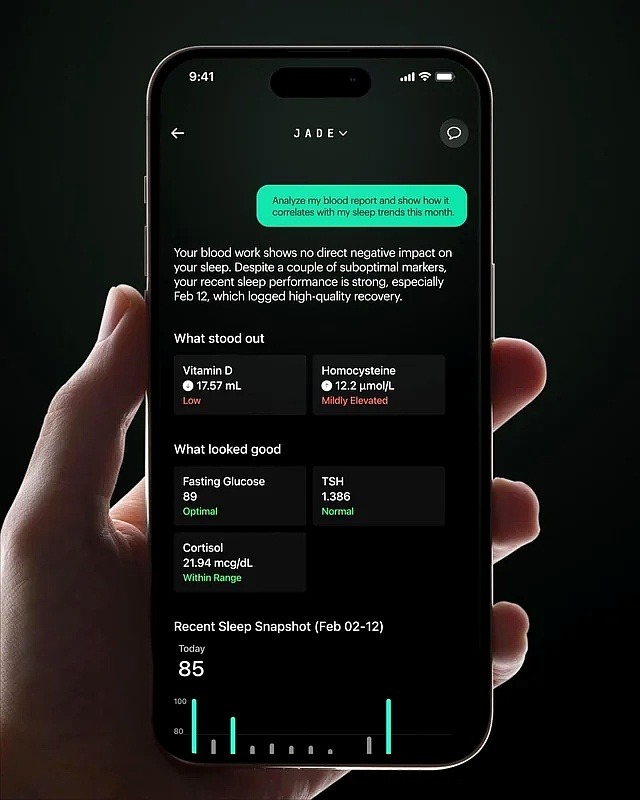
By comparison, with Ultrahuman's JADE AI you’re the one who needs to nudge for specific recommendations and insights. That’s right, it works like a chatbot (Circular’s Kira+ chatbot is also in the works and will be released with future updates). For instance, if you ask why your recovery has been off all week, Jade will pull from your ring data, blood work, and live glucose readings all at once to give an accurate response.
That said, you’ll unlock all of the hidden features of Ultrahuman’s Jade AI only if you are feeding it data from multiple Ultrahuman devices like the M1 CGM glucose patch ($2,039 a year) and Blood Vision blood testing panel. With just the ring, Jade is working from a thinner dataset than Kira, which has access to 140+ biometrics including ECG data that Jade simply doesn’t have. On the ring-level alone, Circular tracks more biometrics for personalized recommendations.
Battery Life: 7 Days (30-Minute Charge) vs 15 Days (3-Hour Charge)
In terms of battery life, the Ultrahuman Ring Pro’s 15-day battery life, with 12 days in turbo, is superior to Circular Ring’s 7 days in power mode, and 5 days in full performance mode. That said, the size of the ring has a direct impact on battery life. So, for example, if you happen to wear a size 8 or 7, you might get -1 day on battery performance under daily use.
As for charging speed, the Circular Ring 2 is ultra fast and tops up your ring from 0 to 100 in just under 30 minutes. The Ultrahuman Ring Pro, on the other hand, requires significantly longer, that is 180 minutes, to charge the ring.
Exclusive Features: ECG vs Ultra Age
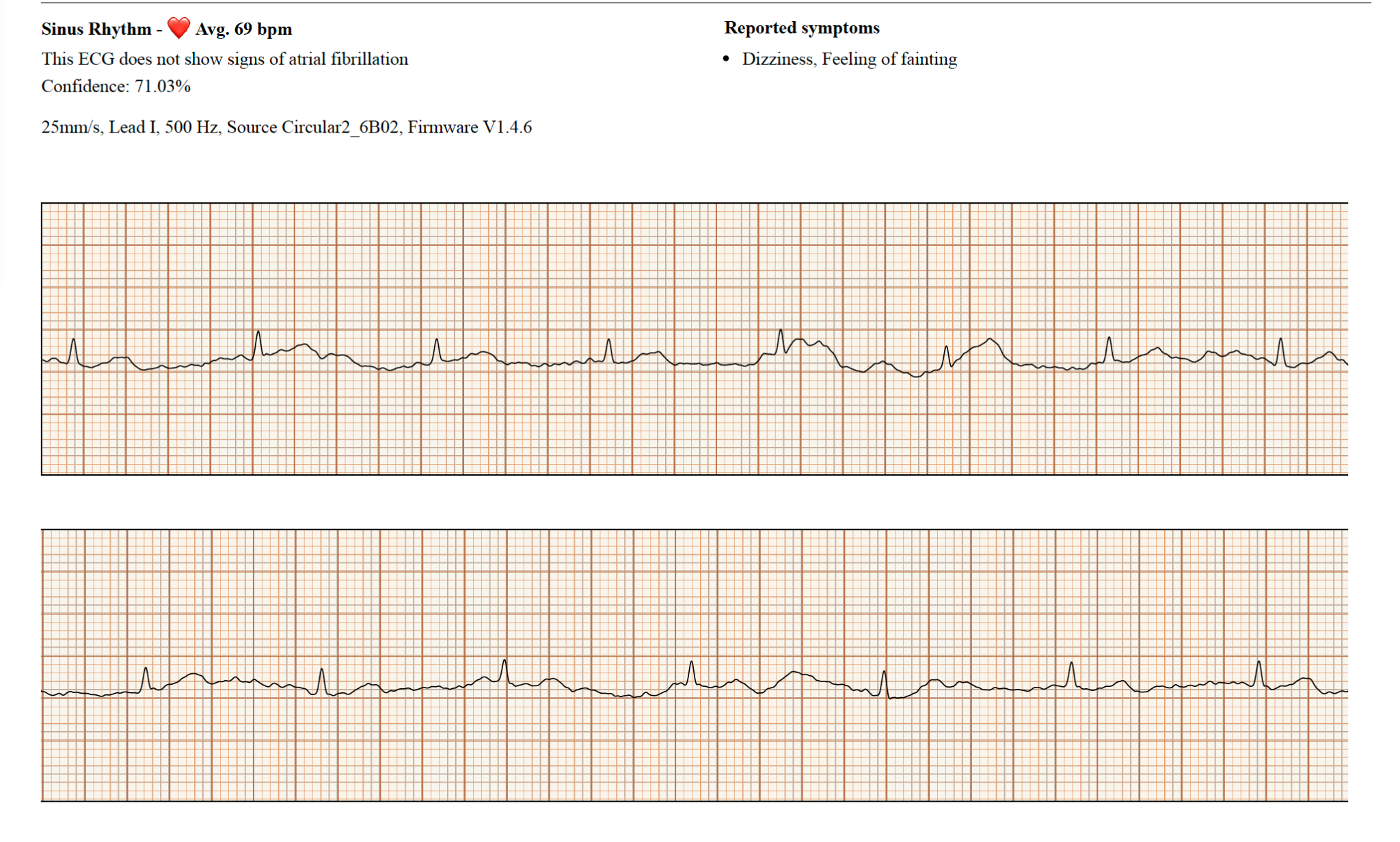
(Credit: Arman K) | Circular Ring 2’s exclusive ECG reading
The exclusive features of a smart ring are the decisive factor for any buyer. So here’s how it goes:
In terms of heart health, the Circular Ring 2 is THE ring to rule them all. It’s the only ring with an ECG sensor capable of detecting Afib, tachycardia, bradycardia, and general arrhythmia, with an on-demand reading. The Ultrahuman Ring Pro does offer AFib detection too, but through a PPG sensor, which is less clinically reliable than a dedicated ECG sensor.
On top of this, when it comes to exclusive features, Circular is the most proactive smart ring that cross-references 140+ biomarkers to greet you with accurate personalized recommendations every morning based on your unique biology.
The Ultrahuman Ring Pro is a beast of a ring when it comes to tracking your biological age across brain age, pulse age, and blood age with the Ultra Age feature, which is also available on the preceding model. Yet, on the Pro model it’s deeper due to advanced hardware and AI integration. Whereas other smart rings and wearables like the Oura Ring 4 and the Whoop also offer a similar feature labeled under “Cardiovascular age” or "Healthspan," their focus is mainly cardiovascular health.
Other exclusive features on the Ultrahuman Ring Pro are the Find My Case feature for those who find themselves rummaging through the drawers to find the case.
Final Thoughts
So are the experts of the wearable sector in unanimous agreement that one is better than the other? No. Both the Circular Ring 2 and the Ultrahuman Ring Pro are among the best advanced smart rings in 2026. Yet, they’re very different in what they offer.
The Circular Ring 2 is the best heart health smart ring, given that it’s the only smart ring with a built-in ECG sensor. On top of that, what it does especially well is coach you on stress, sleep, and recovery with specific daily action plans that are generated by the AI coach, KIRA, upon cross-referencing 140+ biomarkers.
The Ultrahuman Ring Pro features a 15-day battery life, which beats the RingConn Gen 2’s market-leading 10-12 days. The new flagship brings revamped features over the Air model, with better precision, and exclusive features like Find My Case, a new level of ecosystem connectivity and a biointelligent chatbot named Jade. That said, hands-on testing is needed to see how the ring performs in practice.
Frequently Asked Questions
How is the Ultrahuman Ring Pro better than the Ultrahuman Ring Air?
The Pro's battery life alone goes from 7 days to 15,and the charging case adds 45 days of total battery. More upgrades include the Find My speaker, Qi wireless charging, and a year of data backup. The Pro also runs on a dual-core processor with on-chip machine learning.
Is the Circular Ring 2 more advanced than the Ultrahuman Ring Pro?
Depends on what you're after. For heart health and proactive health coaching, the Circular Ring 2 is more advanced. It's the only smart ring with a hardware ECG sensor, accurate AFib detection, and an AI coach that analyzes 140+ biomarkers to generate personalized daily recommendations. For battery life, and ecosystem connectivity, the Ring Pro is the stronger pick.
When does the Ultrahuman Ring Pro launch?
The global launch date for pre-orders of the Ultrahuman Ring Pro was February 27, 2026, while the official United States launch occurred on March 24, 2026. Pre-order price is $479, going up to $530 once the pre-sale closes.
Does the Circular Ring 2 require a subscription for core features?
No. All 13+ core features including ECG, AFib detection come free with the ring.
What are the upcoming Circular Ring 2 features?
Longevity tracking and Kira + conversational AI. With longevity tracking, you’ll get insights into how your biological age is affected by your habits. And Kira+ conversational AI will let you query your health data directly, similar to how Jade works on the Ultrahuman Ring Pro.
Which smart ring is better for heart health?
The Circular Ring 2. It has a dedicated hardware ECG sensor that can detect AFib, tachycardia, bradycardia, and general arrhythmia with an on-demand reading in 40 seconds. The Ultrahuman Ring Pro detects AFib too, but through a PPG sensor, which is considerably less clinically reliable than a hardware ECG. And unlike Circular, AFib detection on the Ring Pro is paywalled at $4.99 a month.
Which Health Tracker Fits Your Life?
Smart ring or chest strap: the right answer depends on your priorities.
- You want to track your health 24/7 without thinking about it? The 2g Circular Ring 2 is worn day and night, including for sleep. A chest strap cannot do that.
- You want to detect heart anomalies like AFib? The Circular Ring 2 is the only smart ring with an FDA-cleared ECG algorithm for atrial fibrillation detection.
- You refuse to pay monthly subscriptions? Circular Ring 2 includes 13+ premium health features, no subscription. Pay once, use for life.
Take the Quiz: See Where You Stand