%201-1.avif)
Circular Ring 2 vs Samsung Galaxy Ring: Which No-Subscription Smart Ring Is Better?
The Samsung Galaxy Ring and the Circular Ring 2 are two of the best smart rings without any subscription. Yet they're built around very different ideas of what a smart ring should, and can, do. After spending the better part of a month with both, I found they differ in pretty much every category, from design and pricing to the exclusive health features each brand offers. Ahead, I’ll break down these differences to help you decide on which will suit your lifestyle better.
Quick Take: Which smart ring should you buy?
Neither ring is universally better. They serve different users, and your choice comes down to two main things: what phone you have, and how deep you want your health data to go.
For most people, Circular gives you more health features like ECG and proactive AI coaching at a lower price. Samsung makes sense mainly if you're already in the Galaxy ecosystem.
Choose the Circular Ring 2 if:
- You want ECG with AFib detection without paying a subscription for 13+ core features.
- You use an iPhone or a non-Samsung phone.
- You want a proactive AI coach (Kira) that cross-references your data to give you specific daily recommendations.
- You want features like coherence training, caffeine windows, and circadian alignment that no other ring offers.
- You want to save $50.
Choose the Samsung Galaxy Ring if:
- You own a Samsung Galaxy phone.
- You want gesture controls that let you fire your camera or silence alarms with a double-pinch of your fingers.
- You tend to misplace things and want Find My Ring to track the ring's whereabouts with the Samsung Find app.
- You want reliable sleep, heart rate, and energy tracking backed by one of the most polished health apps on the market.
.jpg)
Design, Pricing, and Sizing
The Circular Ring 2 costs $349 for the standard black finish, up to $549 for Gold and Rose Gold. By comparison, the Galaxy Ring costs $399 across all colors. Thankfully, neither ring requires a monthly subscription for you to view your health stats. Both the Circular Ring 2 and Galaxy Ring are made of premium titanium with hypoallergenic interior and weigh around ~2-3 grams.
Design-wise, they have different personalities. The Circular Ring 2 has a slightly rounder profile that gives it a more classic ring look. On the other hand, the Galaxy Ring is a tad flatter and with raised edges, which makes it feel more like a… smart ring.
As for sizing, Circular is the only smart ring brand with a digital sizing tool (Samsung sends you a sizing kit before buying). You place your hand with fingers open wide, hold a credit card next to it, snap a photo, and the app gives you your exact size for each finger.
When I tried it, the tool told me my index finger was a size 9 but my ring finger was better off with a size 8. I went for the size 9 for my index finger, and when the ring arrived, the fit was spot on. That said, I’d recommend getting a physical sizing kit to be extra safe. Go about your day wearing the dummy ring in your size and make sure it isn't too tight or loose. Fingers swell and depuff during the day, and you don't want to deal with returns.
Battery Life and Charging
Battery life on both rings is solid, and neither will leave you scrambling for a charger every two seconds. In Performance Mode, which samples data every two minutes, the Circular Ring 2 gets you about four to five days, and up to 6 days in Power Save Mode.
I personally keep it in Performance Mode the entire time because the data is richer, and find myself charging the ring every 4 days. But given that it’s 30-minute fast charging, it tops up the battery during showertime. So there’s that.
Samsung delivered close to its claimed seven days in my testing, which was refreshing given how often battery claims disappoint in real life. Yet, it doesn’t charge as ultra fast as Circular and takes closer to 80 minutes to top up, which is not great not terrible, but you’ll notice the difference once you’ve tried the faster option.
Heart Health
When it comes to heart health, the Circular Ring 2 is a cut above the competition. It’s the only smart ring with an on-demand ECG recording and AFib detection (atrial fibrillation, an irregular heart rhythm that raises the risk of stroke or heart failure). By comparison, the Galaxy ring doesn’t have this.
Besides that, the Circular Ring 2 tracks HRV (heart rate variability), the measure of your natural millisecond-by-millisecond variation in time between consecutive heartbeats, continuously throughout the day in Performance Mode.
Samsung only measures HRV automatically during sleep, giving you one overnight average each morning. In other words, Samsung gives you one HRV number each morning that tells you how well you recovered, whereas Circular samples HRV all day every day so Kira can show you what drained your recovery in the first place, and how to recover fast.
Importantly, both rings have a live measurements feature. However, Circular has a significant edge here because it gives you a real-time dashboard for four metrics --live heart rate, oxygen saturation (SpO2), and raw HRV, whereas the Samsung Galaxy Ring restricts live streaming to heart rate only.
Sleep Tracking
The Galaxy Ring and the Circular Ring 2 track sleep stages and vitals very well, so let’s not get into all of that. That said, they diverge in two areas: Samsung has phone-enabled snore detection that Circular doesn't, and Circular has advanced AI coaching that Samsung doesn't.
What I like most about Samsung’s sleep tracking is snore detection. It works by placing your phone on the nightstand overnight. The ring and phone work together to record audio and detect snoring patterns. As of writing, Circular doesn’t provide this feature.
Circular’s advantage, however, is AI coaching, which is stronger than what Galaxy Ring’s AI offers. Kira (Circular’s AI coach) cross-references 140+ biomarkers including sleeping heart rate, sleep stages, and so forth, to generate personalized recommendations with a single tap.
On nights where your sleep quality plunges, for example, Kira asks you to confirm what contributed to the dip from a list of things including alcohol, late caffeine, etc.--all in the companion app.
If your deep sleep doesn’t meet the minimal threshold, Kira will detect the culprit (stress, caffeine, etc) and give you a specific action plan for today to bounce back with recommendations the likes of hydrating with electrolytes, doing guided breathing for a set amount of time, and getting outside for some sunlight early to keep your circadian rhythm on track. On top of that, it gives you a target bedtime for that evening so you can recover fast without digging the hole any deeper.
There's a difference between "your sleep score is low, rest today" and "your HRV dropped, your breathing rate was elevated, and your body temperature spiked at 3am, ease off today and here's why."
Stress Tracking
What Circular has that Samsung doesn't is hourly stress predictions. The app maps out where your stress levels are likely headed (thanks to Kira) for the rest of the day based on your biometric patterns, and you can tie those readings to personal notes so Kira builds a picture of your actual triggers over time.
On a busy afternoon, I could see a spike predicted for later in the day, and it turned out to be accurate. In other words, Samsung tells you where you are, whereas Circular tells you where you are AND where you are headed.
Beyond the predictions, Circular’s Coherence feature gives you something to actually do about stress rather than just measure it with guided breathing exercises for different purposes like calming yourself down quickly, improving sleep quality, sharpening focus, and more.
Three minutes of HRV biofeedback and you can watch your score climb in real time as your breathing steadies. I did a session after a rough afternoon and my coherence score went from 42 to 71. Samsung has breathing exercises too, but there's no tangible biofeedback behind them like there is with Circular.
AI Coaching: Proactive vs Reactive
The Circular Ring 2 outpaces the Galaxy Ring with the proactive nature of its AI coaching. Samsung's Galaxy AI is reactive: it processes your data and presents it back to you in a readable format with basic recommendations. Circular’s AI coach, Kira, is forward-looking.
On the 20th day of wear, meaning the calibration for both rings was well past its window, Kira told me my sleep efficiency had dropped below 70% three nights that week and that my stress score had been peaking each afternoon.
It recommended moving my intense workouts to before 11am and avoiding screens in the hour before bed, then told me my HRV should recover within three to four days if I made those adjustments.
Samsung's wellness tips are useful but are slightly generic. One week it told me I had practiced better sleep habits than the week before, averaging an 85% sleep habit achievement rate. Encouraging, but it’s not the same as being told exactly what to change and when to expect results.
Circadian Alignment
This is a feature that most smart rings don't have, but both Circular and the Galaxy Ring do. Samsung's Sleep Time Guidance suggests an optimal bedtime based on your patterns. That's it.
Circular's Kira, on the other hand, told me after a week of late nights that my rhythm had shifted by 47 minutes and that my deep sleep had taken a hit because of it. I found that oddly specific in the best possible way. The Galaxy Ring flagged the late bedtimes too, yet it never told me the exact reason or what I could do about it.
Here's how Circular's AI works. After a rough night, Circular asks what was behind it and gives you options to choose from: too much or late caffeine intake, stress, alcohol, and so forth, so it can cross reference your answers with your metrics and make sense of it all. Samsung's AI is not that robust just yet.
*In a nutshell, both rings reliably track your sleep stages and include a circadian alignment feature, but unlike Circular, the Galaxy Ring doesn't have a proactive AI coaching layer.
Energy Analysis
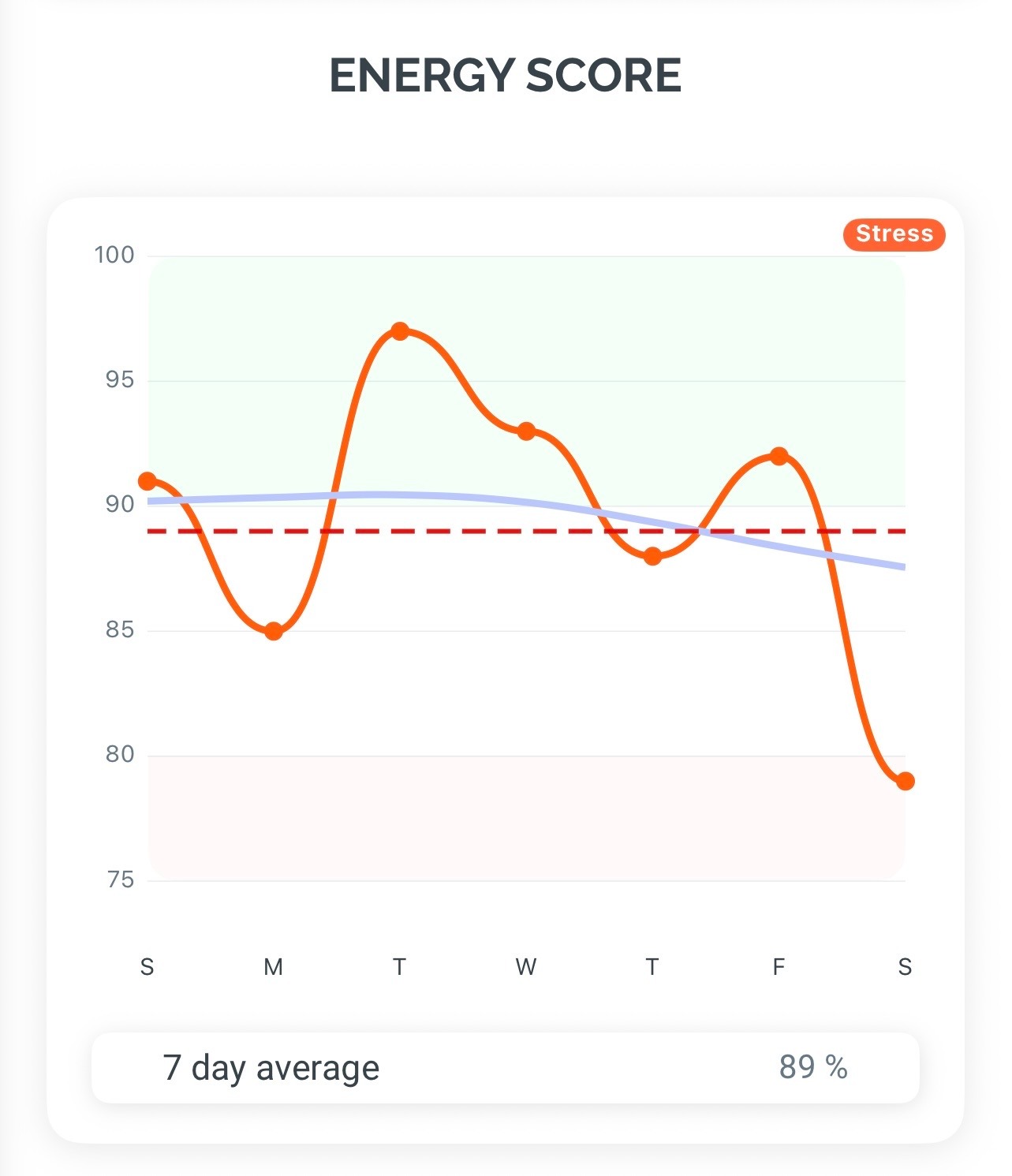
The Energy Score is the first thing I check every morning on both rings. On Samsung, it sits right at the top of the app as a number out of 100, rated from Poor to Excellent, with a breakdown across sleep, activity, and heart rate. The Wellness Tips are a nice touch too. One week after sleeping more consistently, it told me my sleep habit achievement rate had jumped from 52 to 85 percent. Hard not to feel good about that.
(Circular Ring 2 - Energy Analysis)
Circular's Energy Score works the same way, but where Samsung tells you which category dragged your score down, Kira tells you exactly which metric was responsible and what to do about it. One morning after a rough night she told me my HRV had dropped, my resting heart rate was elevated, and that I should skip the gym and focus on recovery. Samsung gave me a low score that same morning. It just never told me why or what to do about it.
Women’s Health
I couldn't test this one personally, partly because I don't have the biology for it, and partly because no amount of dedication to journalism was going to change that. So I did the next best thing and researched what women who had tested both rings actually experienced.
Samsung tracks your cycle through overnight skin temperature, heart rate, sleep stages, and respiratory rate, all fed into the Samsung Health app. It predicts your period and fertile window, which women who tested it said felt surprisingly accurate. The catch is that Samsung's Natural Cycles integration is limited, so you get period tracking and prediction but not the full fertility planning suite.
Circular's approach is more phase-specific, and more useful if you think about what cycle tracking should actually do. During the menstrual phase, Kira can recommend rest and lower intensity activity; in the follicular phase, it nudges you toward harder workouts as energy returns; the ovulatory phase gets marked as your peak performance window.
And in the luteal phase, Kira adjusts its coaching to account for the natural HRV dip most women experience before their period. Circular also covers menopause and broader reproductive health, which Samsung does not address at all. The difference is a ring that logs your cycle versus one that coaches you through it.
Verdict: Which is the stronger buy overall?
For most buyers, the Circular Ring 2 is the stronger buy. The biggest reason is that it works on any phone, whereas the Galaxy Ring is confined to the Samsung ecosystem only. On top of that, Circular offers advanced health features like ECG recording and proactive AI coaching that the Galaxy Ring simply doesn't have.
The Galaxy Ring mostly makes sense for loyal Samsung users who are already in the ecosystem with a Galaxy phone and Galaxy Watch, and who'd want the ring to work alongside both for better precision and additional features like phone-enabled snore detection.
FAQs:
Does the Samsung Galaxy Ring require a subscription?
No. The Samsung Galaxy Ring has no monthly subscription. All core health features are included in the one-time purchase price of $399.
How long does the battery last on the Circular Ring 2?
Up to 7 days in Eco Mode, and around 4 to 5 days in Performance Mode, which samples data every two minutes for richer tracking detail. It fast-charges to full in 30 minutes.
Does the Samsung Galaxy Ring work with an iPhone?
No. The Samsung Galaxy Ring requires a Samsung Galaxy phone running Android 11 or above. It does not work with an iPhone.
Does the Circular Ring 2 have a monthly fee?
No. The Circular Ring 2 has no subscription. All 13+ core features, including ECG, AFib detection, and Kira AI coaching, are included in the purchase price with no ongoing fees.
Can the Samsung Galaxy Ring track ECG?
No. The Samsung Galaxy Ring has no ECG sensor. The Circular Ring 2 is currently the only smart ring with an on-demand ECG recording and AFib detection.
Is the Circular Ring 2 waterproof?
Yes. The Circular Ring 2 is fully waterproof.
Is the Circular Ring 2 good?
Yes, and it's widely recognized as the most feature-rich smart ring on the market. It's the only smart ring with an on-demand ECG sensor, and it comes with continuous HRV tracking, proactive AI coaching through Kira, guided breathing with real-time biofeedback, hourly stress predictions, advanced sleep analytics, and circadian alignment coaching.