%201-1.avif)
How Circular Ring 2 Measures Blood Pressure Without a Cuff
Blood Pressure is now live in the Circular app. Here's how it actually works, why it matters, and what the numbers mean. Blood pressure is one of the most consequential numbers in preventive health, and one of the least measured. Most people check it once or twice a year, in a clinic, sitting in a chair they arrived at in a hurry. That single reading then has to represent a value that moves all day long. Starting today, every Circular Ring 2 owner can measure blood pressure directly from the app, at no extra cost and with no subscription. This post isn't a feature list. It's an explanation of the physics, because a health number you don't understand is a number you won't act on.
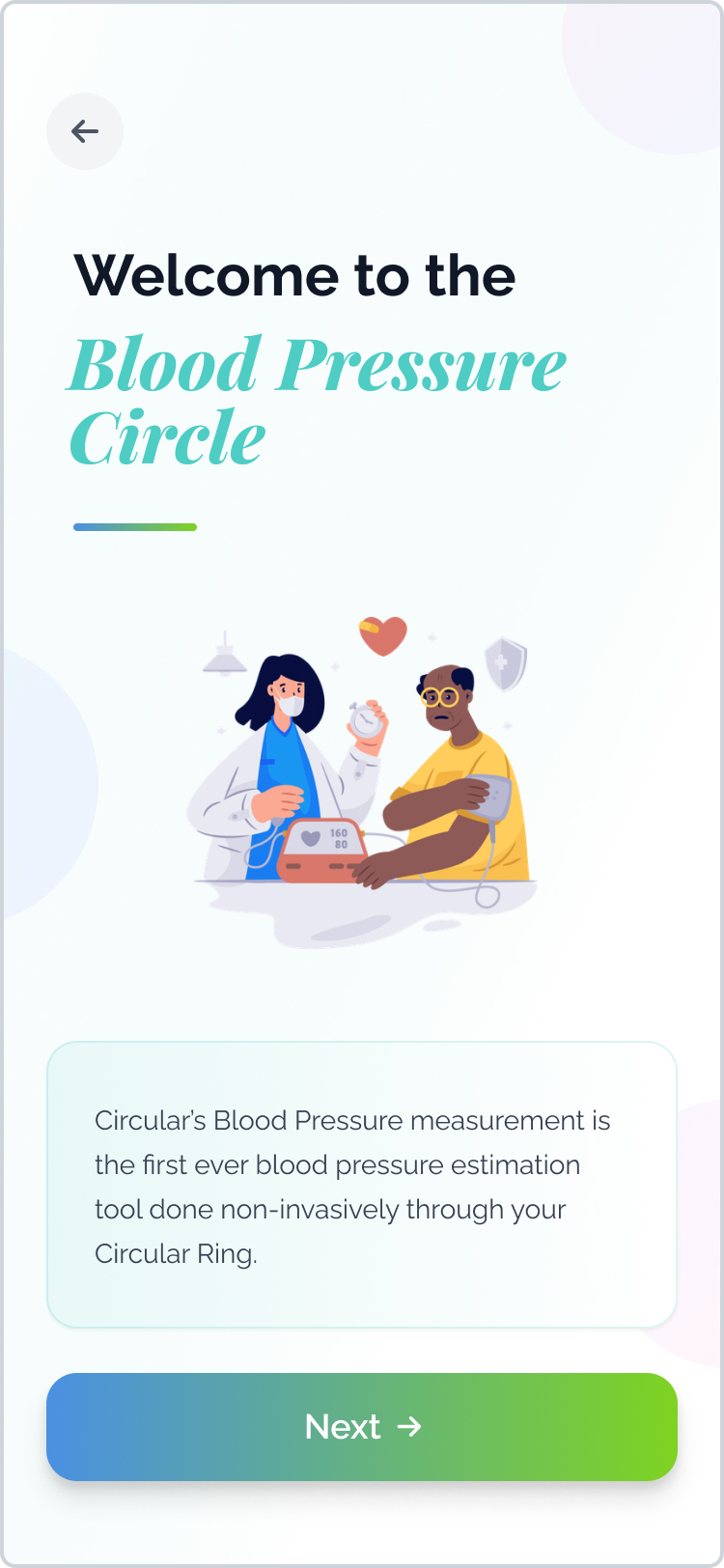
Blood Pressure, now available in the Circular app
What is blood pressure?
Blood pressure is the force your blood pushes against your artery walls as it circulates. It's recorded as two numbers, measured in millimetres of mercury (mmHg):
- Systolic pressure (the top number) is the pressure when your heart contracts and pushes blood out.
- Diastolic pressure (the bottom number) is the pressure when your heart relaxes between beats.
A healthy reading is typically around 120/80 mmHg. The European Society of Hypertension classifies results into six bands: Optimal, Normal, Elevated, and Hypertension stages 1 through 3. The higher the numbers, the harder your heart and arteries are working, and the more strain they're under over time.
Why monitoring blood pressure matters
Blood pressure is a silent signal. High blood pressure usually has no symptoms until it has already damaged your blood vessels, kidneys, brain, and heart. It's a leading risk factor for stroke, heart attack, and kidney disease, which is exactly why it's worth watching before it becomes a problem.
A single reading at a clinic twice a year isn't enough. Your pressure moves all day long with stress, sleep, caffeine, exercise, and posture. Catching a trend early, before it crosses into a higher band, is where regular measurement pays off.
And here's the gap most wearables leave: a device that tracks sleep, heart rate, and SpO2 but can't measure blood pressure is missing one of the most consequential cardiovascular signals there is. A smart ring that adds blood pressure gives you a fuller picture of your heart, not just your sleep.
How does Circular Ring smart ring measure blood pressure without a cuff?
A blood pressure cuff works by squeezing your arm. It inflates until it fully closes an artery, then slowly releases while it listens for the moment blood starts flowing again. That's how it gets a reading. But a ring can't squeeze anything. It sits on your finger with no cuff, so instead of pushing on an artery, it measures how fast your pulse wave travels.
Every heartbeat sends out two signals that the ring can time:
- An electrical signal. When your heart beats, it fires a small electrical pulse, visible as the R peak on an ECG (electrocardiogram) trace. This is the starting gun.
- A mechanical wave. That same heartbeat pushes a wave of blood down your arteries. A fraction of a second later, the wave reaches your finger and changes how much light your skin absorbs. That's the PPG (photoplethysmography) signal.
The gap between those two signals is Pulse Wave Transit Time, or PWTT.
Here's the key idea: when your arteries are stiffer and under more pressure, the wave travels faster. When your pressure is lower, the wave travels slower. So by measuring how fast the wave moves, the ring can estimate your blood pressure. This link between wave speed and blood pressure is well studied and is the basis of all cuffless blood pressure research.
To do this, you need both signals from the same device, at the same heartbeat. Most wearables only have PPG, which shows the wave but gives no electrical starting point to time it from. Circular Ring 2 captures ECG and PPG at the same time, which is what makes it possible to calculate that timing from a finger.
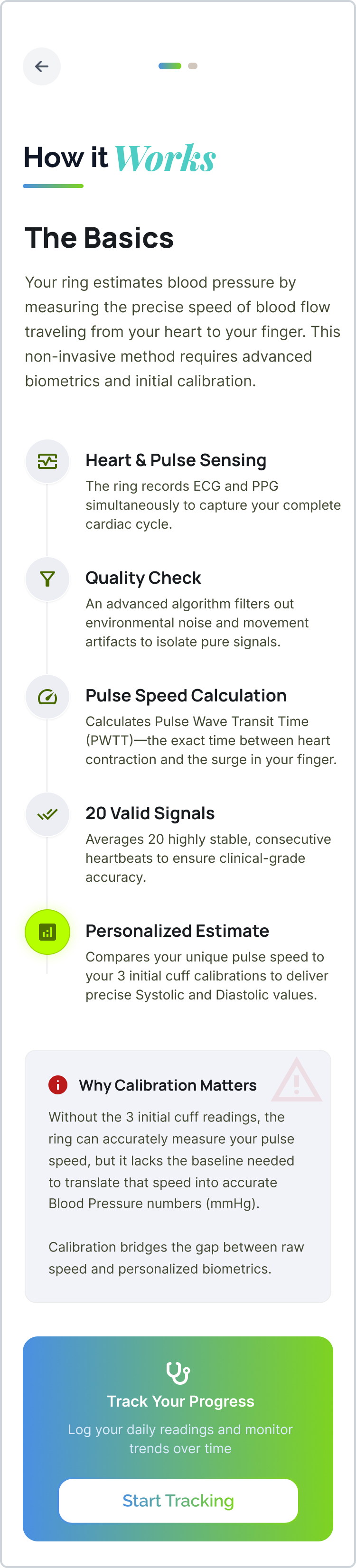
ECG and PPG recorded together make transit time computable
How to take a blood pressure reading with your Circular Ring 2 smart ring
An ECG requires a closed circuit across the body. The ring carries electrodes on its inner and outer surfaces, but the outer one does nothing until you complete the loop. So during a measurement you rest a finger from the opposite hand lightly on top of the ring. Current path runs up one arm, across the chest, down the other.
Light contact matters more than firm contact: pressing hard compresses the tissue under the sensor and adds noise to the PPG side of the calculation.
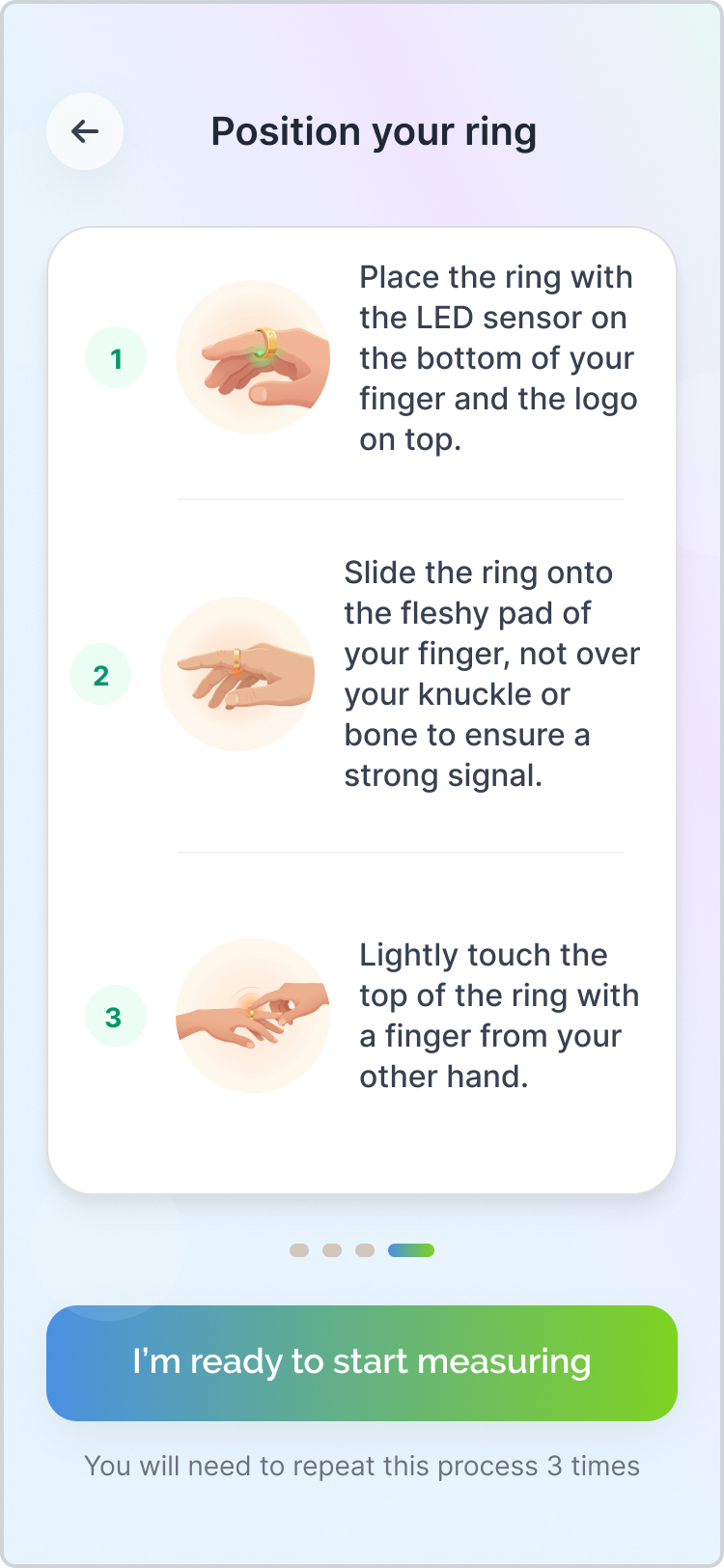
Light contact from the opposite hand closes the ECG circuit
Why the Circular Ring 2 smart ring waits for 20 valid beats
A single beat's transit time is a noisy estimate. Micro-movements of the hand, ambient light leaking under the ring, breathing, changes in contact pressure: all of them shift the arrival time of the pulse by more than the signal we are trying to resolve.
Rather than smooth over that with interpolation, the algorithm filters aggressively and discards any beat that does not meet its quality bar. The counter you see on screen only advances on beats that survive. A session runs roughly 60 seconds and ends when 20 consecutive high quality beats have been captured. If your hand moves, the counter simply takes longer.
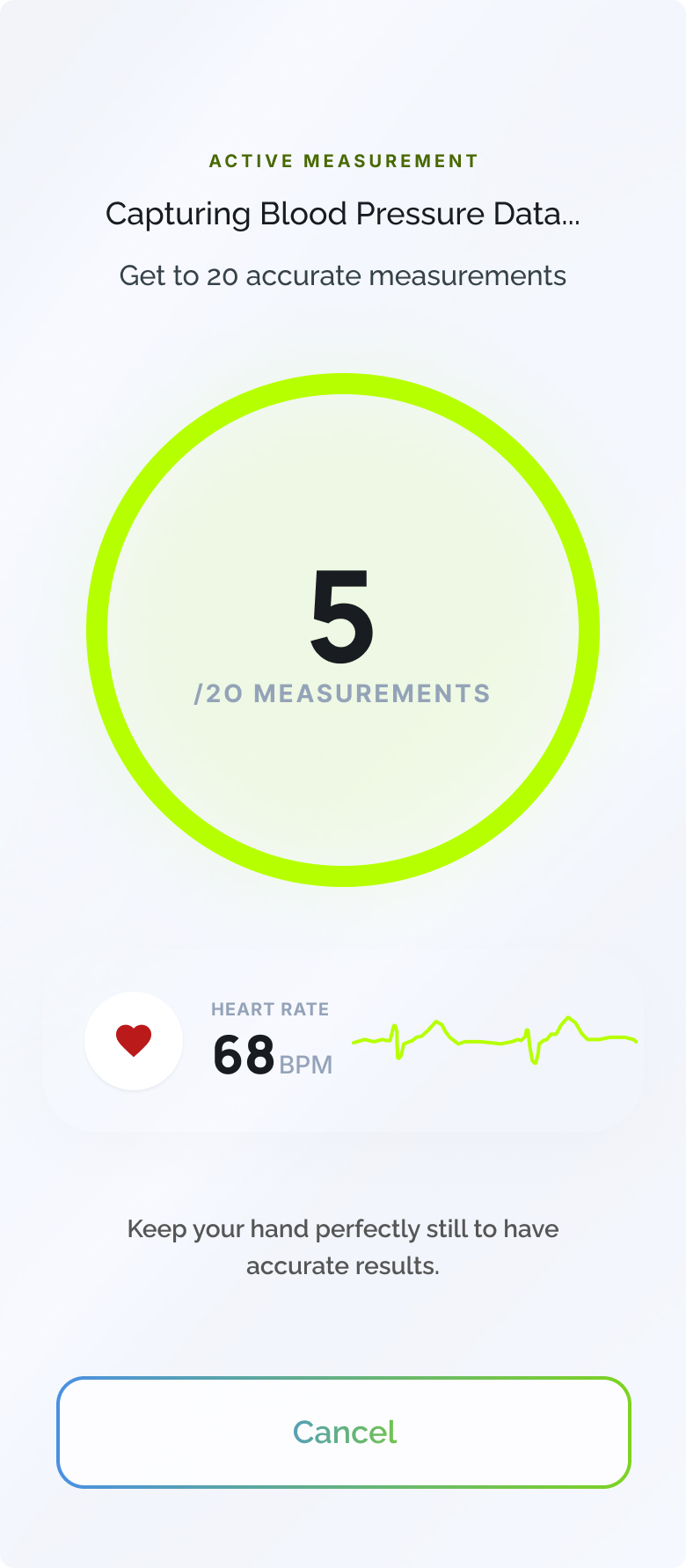
The counter only advances on beats that pass the quality filter
Do you need a cuff to calibrate a smart ring?
This is the part most cuffless products are vague about, so we'll be direct. Transit time tells you how fast your pulse wave is travelling. It doesn't tell you millimetres of mercury. The conversion between the two depends on your individual arterial stiffness, vessel geometry and finger anatomy, and those aren't knowable from the signal alone. So the ring can measure your pulse speed accurately while still having no idea what your pressure is in absolute terms.
Calibration supplies the missing anchor.
At setup: you take three readings with a standard cuff monitor and enter them. Those three points establish your personal relationship between transit time and mmHg. Every 30 days: one further cuff reading re-anchors the model, because arterial properties drift with age, weight, medication and season.
Think of it as setting the time on a watch. The mechanism is precise from the moment it leaves the factory. It still needs to be told what time it is. Any cuffless device promising zero calibration is either applying population averages to you silently, or it isn't solving this problem. We'd rather ask for two minutes a month and show you where the number comes from.
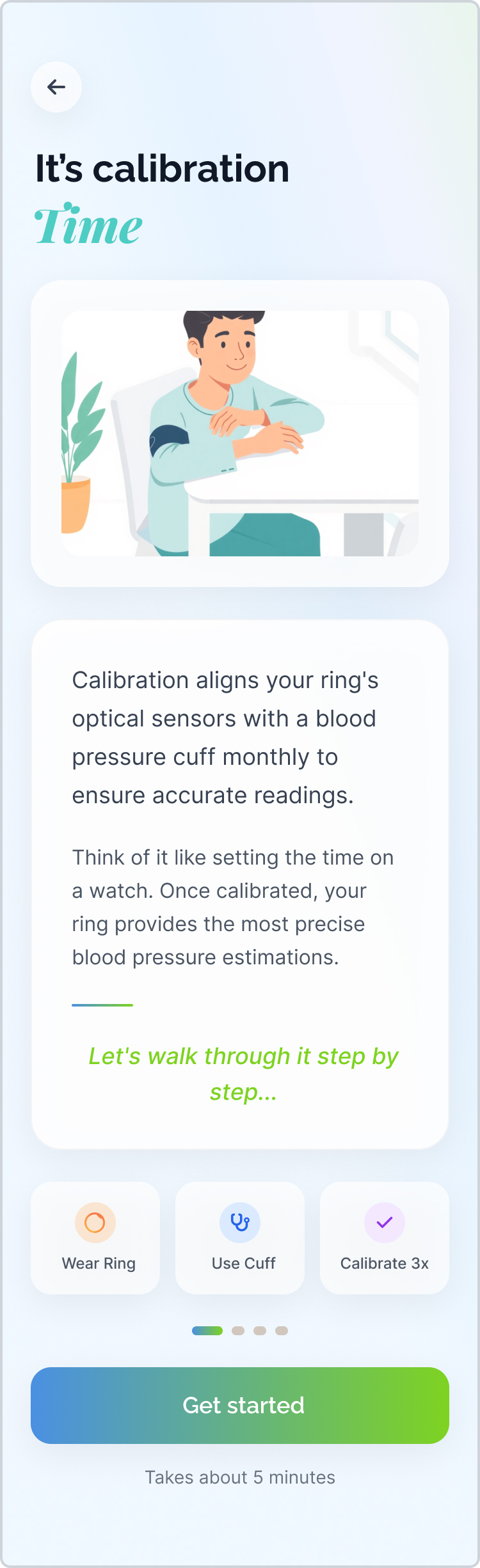
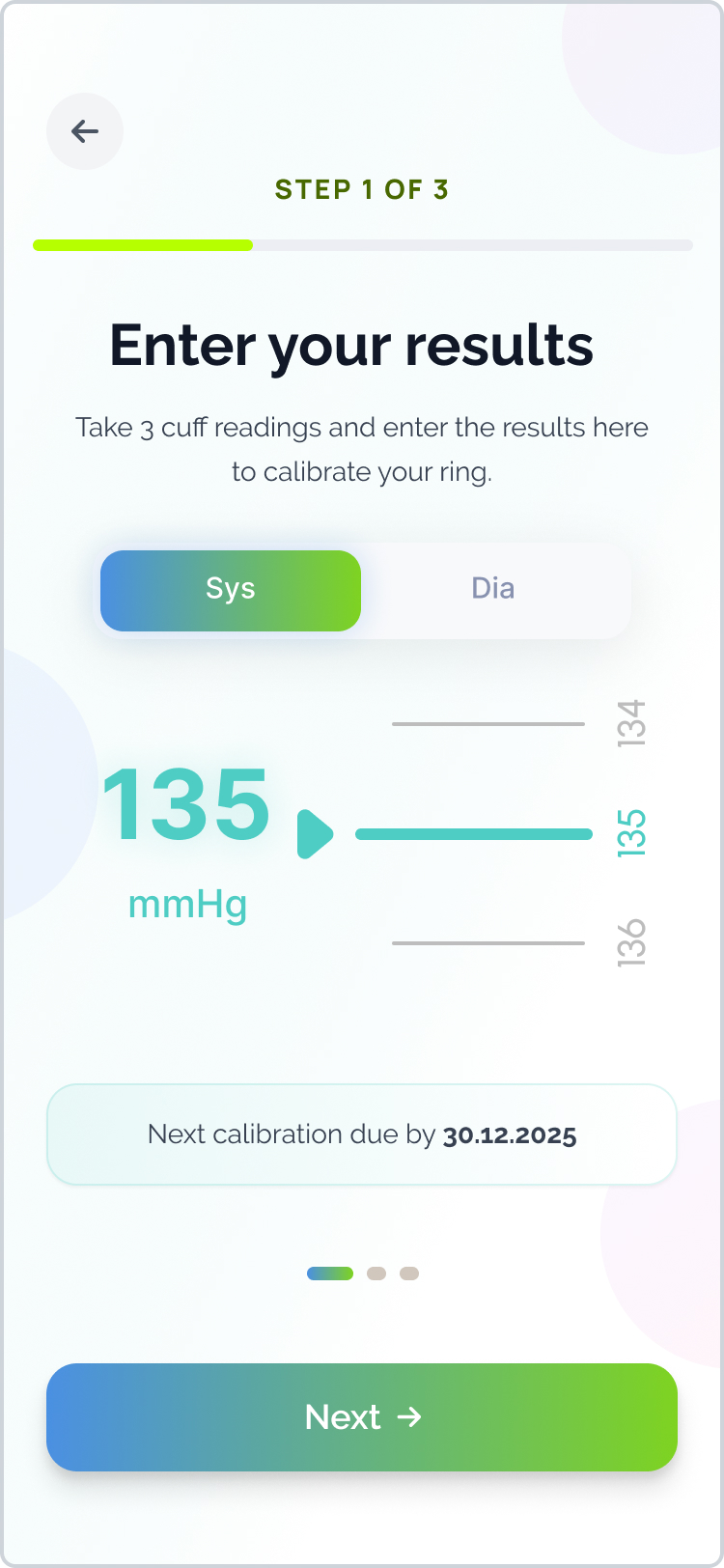
Three cuff readings at setup, one per month after
How to get an accurate blood pressure reading
Measurement conditions affect blood pressure more than most people expect, which is why the app walks you through them rather than assuming you know. Following European Society of Hypertension guidance, the calibration flow asks you to confirm you've avoided caffeine, exercise, alcohol, food and smoking in the previous 30 minutes, and to sit quietly for five minutes beforehand. It then covers posture: back straight and supported, both feet flat on the floor, arms resting on a flat surface.
None of this is ceremony. A brisk walk up the stairs before a reading moves systolic pressure by more than the difference between two of the classification bands below.
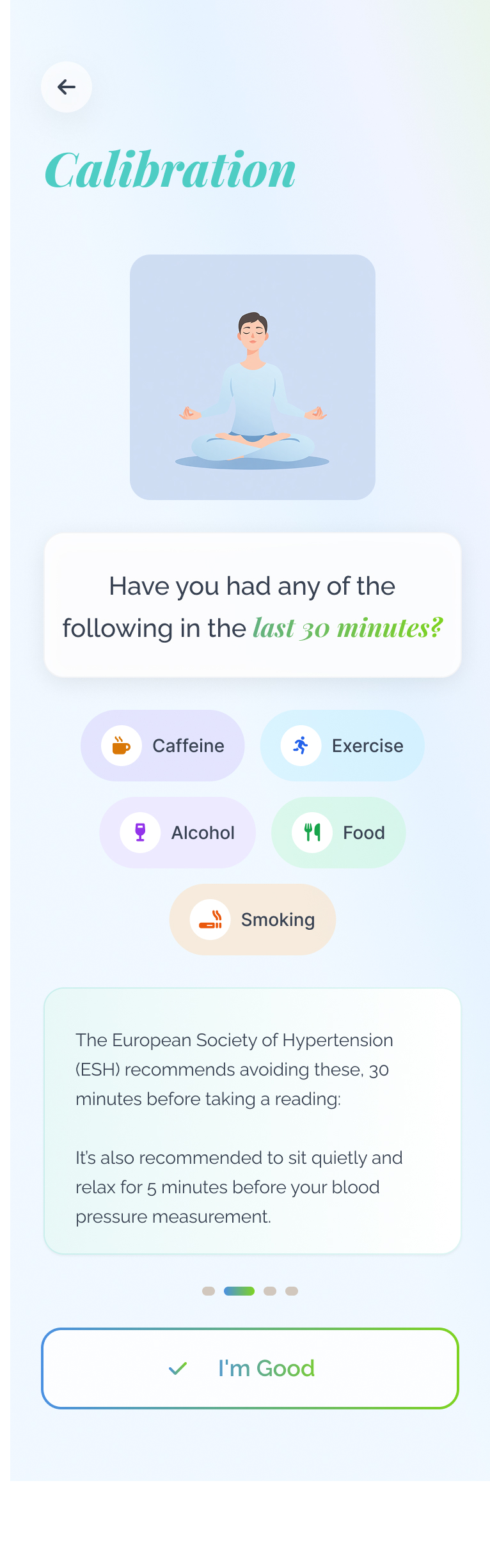
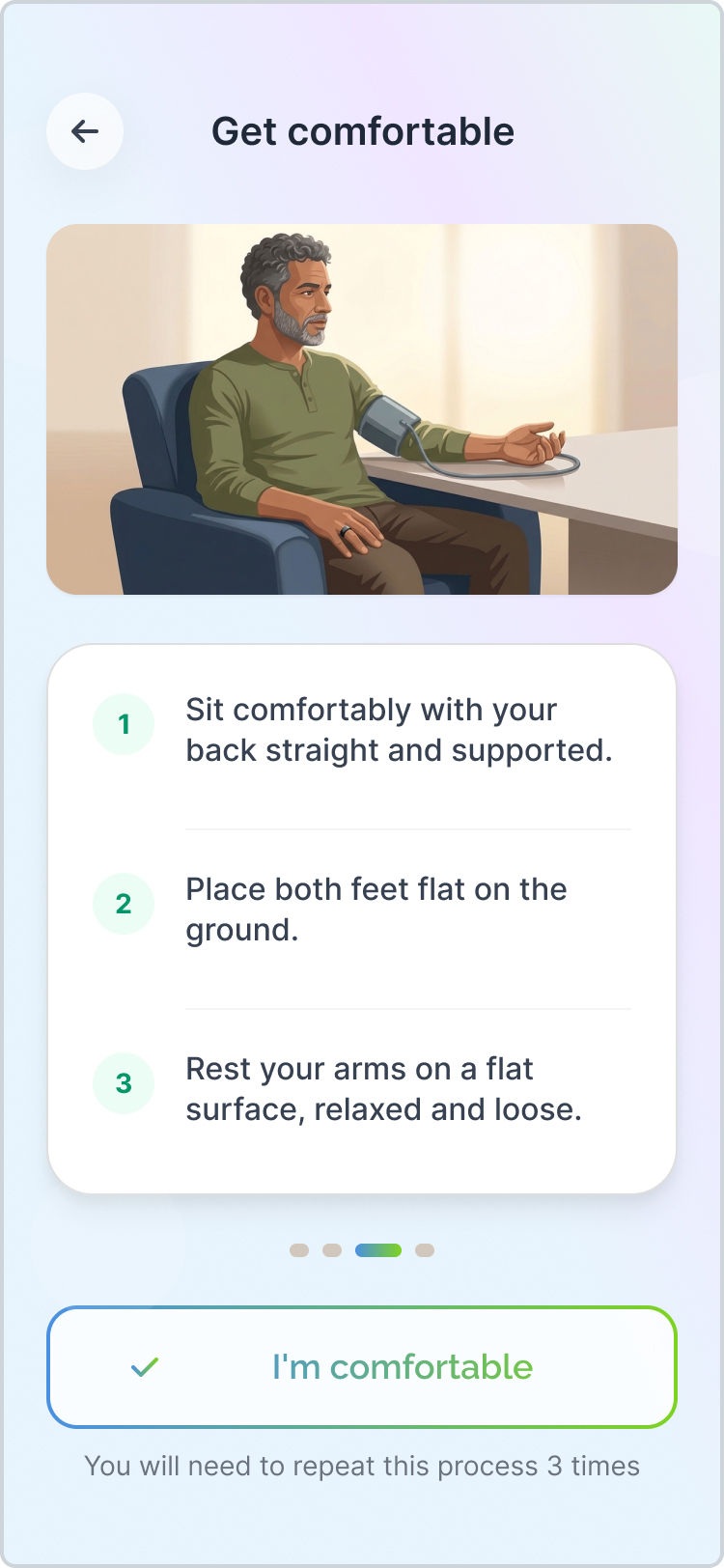
ESH guidance built into the flow
What your blood pressure results mean
Each session returns a systolic and diastolic estimate, timestamped, with your heart rate captured alongside it. Results are classified across six bands aligned with the European Society of Hypertension categories: Optimal, Normal, Elevated, and Hypertension stages 1 through 3.
The free version includes unlimited measurements, your daily view with the average across every reading that day, a full list of the day's sessions, a running count of how your historical results fall across the bands, and a contextual health tip on each result. Alongside it sits a short education library covering what the two numbers represent, and what sustained high pressure does to your kidneys, your brain and your long term life expectancy.
Blood pressure is a silent condition. Nothing about it feels like anything until it has already caused damage, which is exactly why frequent measurement beats occasional measurement.
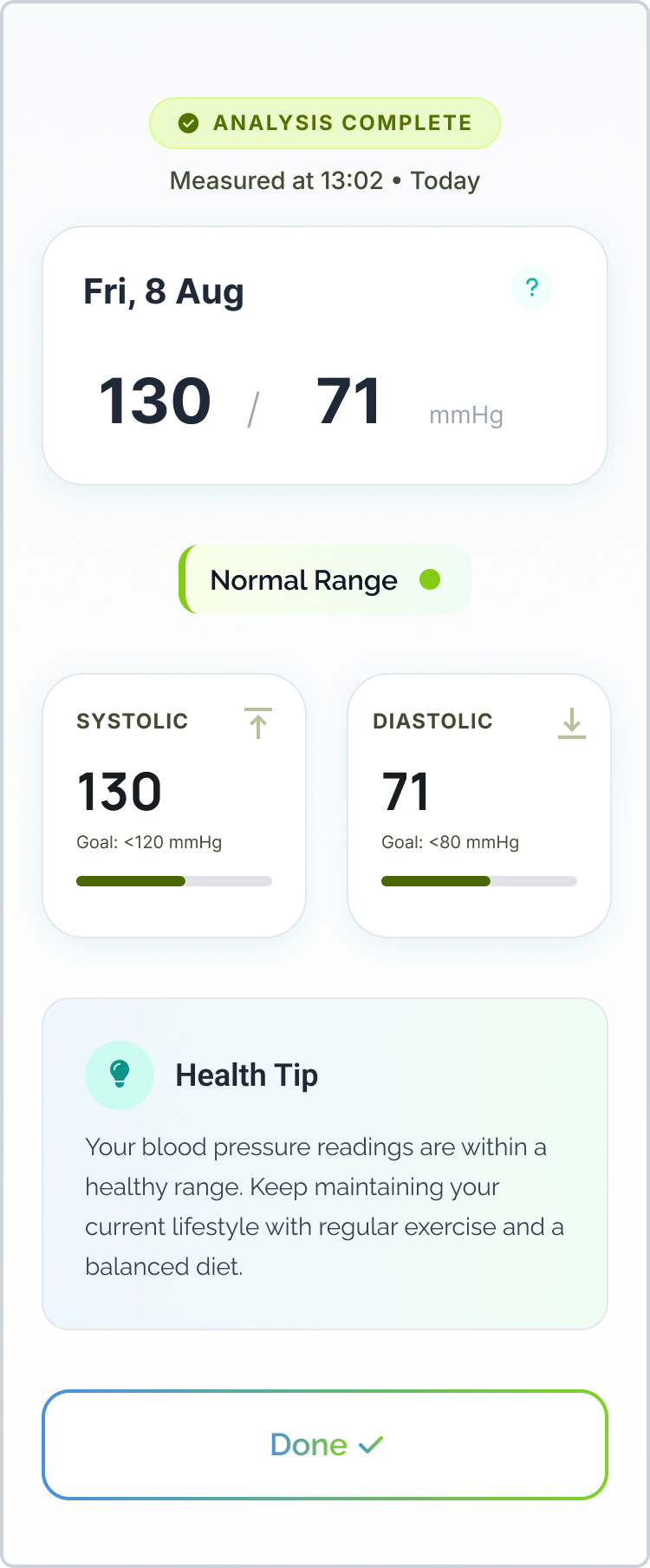

Result classification and daily overview
Measure blood pressure, sleep, and 140+ biomarkers on the Circular Ring 2, the only smart ring with ECG. Learn more
What's next for Blood pressure monitoring
Longer horizon analysis, time in target range, and a shareable PDF summary for your doctor are in development. We're still tuning the precision of those insights, and we won't ship them until the numbers hold up.
Two things to know about what's ahead. First, these advanced insights will be a premium part of the feature, unlocked through Circular Coins or a payment. The core blood pressure measurement stays free. Second, your blood pressure readings will feed into Kira's recommendations, so Kira can coach you on pressure trends alongside sleep, recovery, and activity. If you want to hear when they land, the newsletter on our site is the place.
Is Circular Ring 2 a medical device?
Circular Ring 2 is a wellness device, not a medical device. It is not intended to diagnose, treat, cure, or prevent any disease or medical condition. The blood pressure values in the app are estimates for wellness tracking and trend awareness only, and they must not be used for diagnosis, treatment, or any medical decision, including starting or adjusting medication.
If your readings sit consistently in the elevated or hypertensive bands, the correct next step is always a conversation with a qualified healthcare professional and a reading on a clinically validated cuff, not a change you make on your own.
The ECG feature is powered by an FDA-cleared classification algorithm. That clearance applies to the algorithm only, not to the hardware or the device itself, and it does not make the Circular Ring 2 a medical device.
What the ring gives you is the thing a twice yearly clinic visit cannot: enough data points to know whether that conversation is worth having.
About your data: your health information is processed on secured servers that are HIPAA and GDPR compliant. Your data is anonymized and segmented, it belongs to you, and it is never shared with other users or pooled. Circular does not sell your health data.
Update your Circular app to get started. Calibration takes about two minutes.
Take the Quiz: See Where You Stand
Frequently Asked Questions
Q: Do I need a cuff to use blood pressure on Circular Ring 2?
A: Yes, for calibration. You take three readings with a standard cuff monitor at setup, then one further reading every 30 days to re-anchor the model. Between calibrations the ring estimates pressure from pulse wave transit time, no cuff needed.
Q: How accurate is the blood pressure estimate?
A: It's an estimate for wellness tracking and trend awareness, not a medical measurement. It isn't a replacement for a validated cuff for diagnosis. Calibration against your own cuff is what anchors the estimate to your body.
Q: Why do I need to touch the ring with my other hand?
A: An ECG needs a closed circuit across the body. Resting a finger from the opposite hand on the outer electrode completes the loop, so the ring can time the electrical signal and the pulse wave on the same heartbeat.
Q: How long does a measurement take?
A: Roughly 60 seconds, or until 20 consecutive high quality beats are captured. If your hand moves, the counter simply takes longer.
Q: Is blood pressure free?
A: The core blood pressure measurement is free, with unlimited measurements and no subscription. Advanced insights like time in target range and the doctor PDF will be a premium feature.
Q: Is Circular Ring 2 a medical device?
A: No. It isn't a medical device, and the blood pressure values are wellness estimates. If your readings sit consistently high, talk to your doctor and confirm with a validated cuff.
References
- Toward Ubiquitous Blood Pressure Monitoring via Pulse Transit Time, Mukkamala R, et al. IEEE Transactions on Biomedical Engineering, 2015.
- 2023 ESH Guidelines for the management of arterial hypertension, Mancia G, et al. Journal of Hypertension, 2023.
- A review of methods for non-invasive and continuous blood pressure monitoring, Peter L, Noury N, Cerny M. IRBM, 2014.
- Circular Ring 2 Product Page, Circular.