%201-1.avif)
Can a Smart Ring Detect Sleep Apnea? What the Science Says
Sleep apnea affects an estimated 1 billion people worldwide, yet 80% of cases remain undiagnosed. The reason is simple: the gold standard for diagnosis is an overnight polysomnography in a sleep lab, a process that is expensive, inconvenient, and intimidating enough that most people never schedule one.
Introduction: The Silent Epidemic
But what if the device already on your finger could give you an early warning?
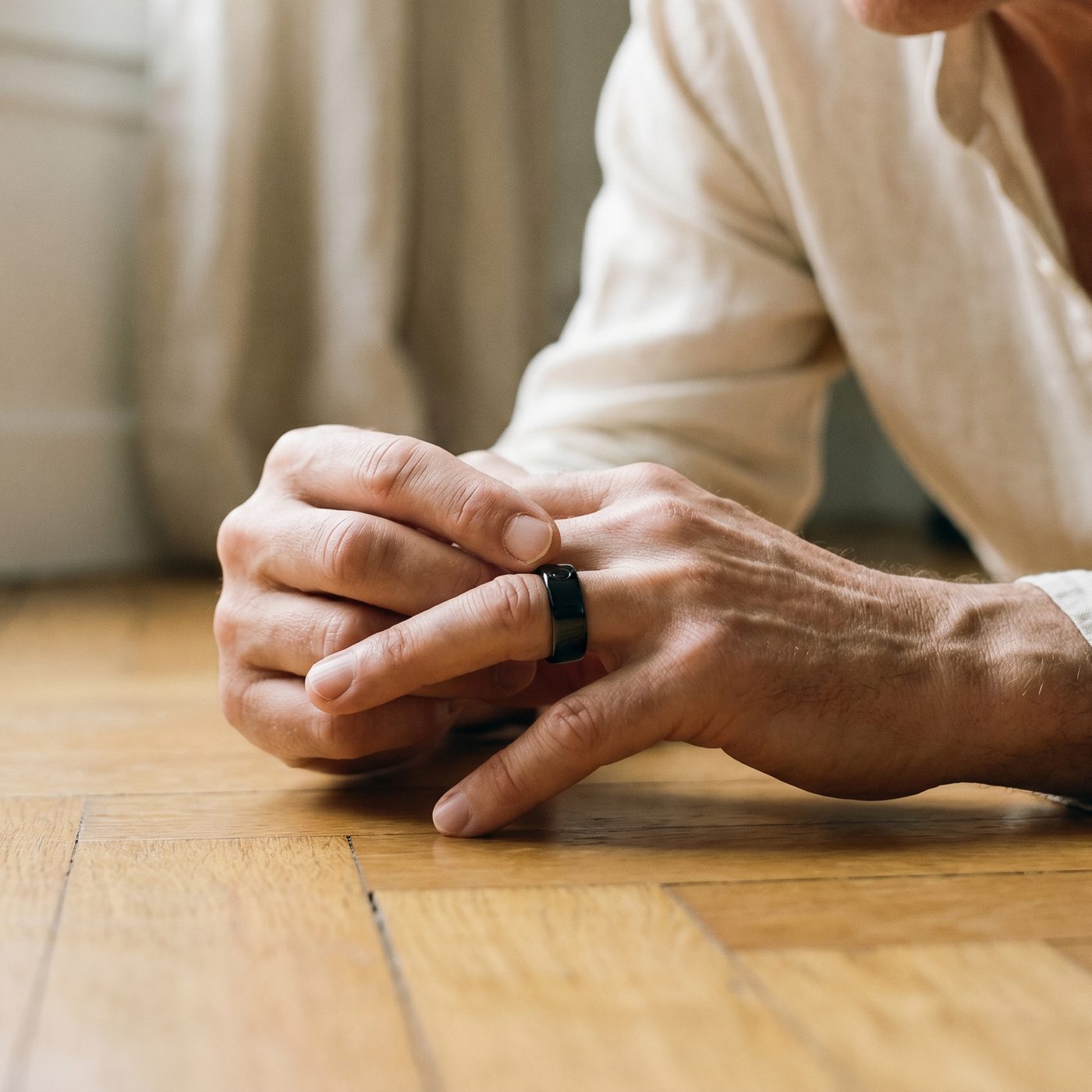
Smart rings have evolved from simple step counters into sophisticated health monitors capable of tracking blood oxygen saturation (SpO2), heart rate variability (HRV), respiratory rate, and sleep stages throughout the night. The Circular Ring 2 goes further, with continuous SpO2 monitoring, sleep stage tracking, and an FDA-cleared algorithm for health insights. So the question is obvious: can a smart ring actually detect the signs of sleep apnea?
The answer is nuanced. A smart ring cannot diagnose sleep apnea, but it can screen for the warning signs with enough accuracy to prompt you to see a doctor. Here is how.
How Sleep Apnea Works (and Why It Is Hard to Catch)
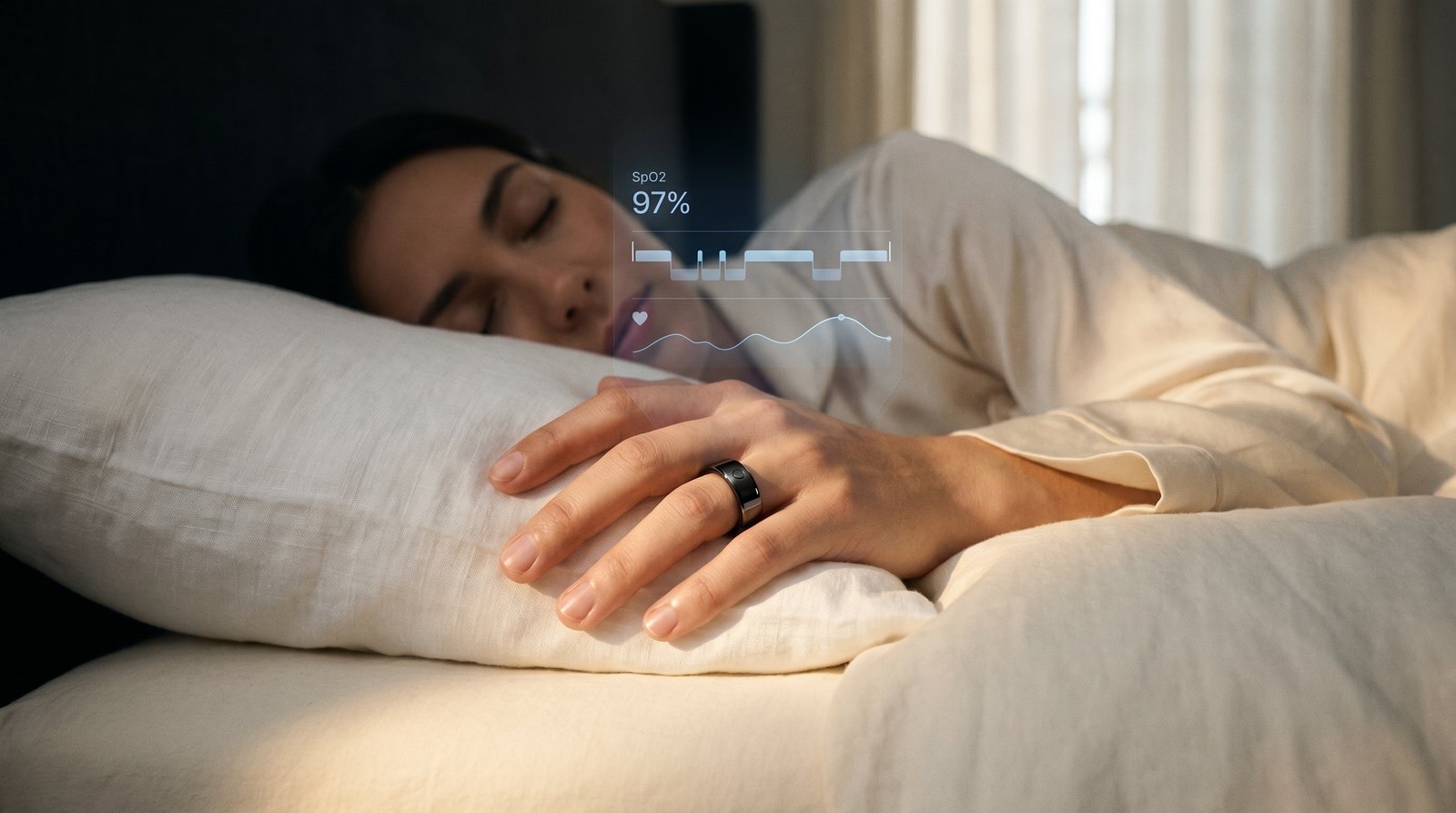
Sleep apnea is a condition where breathing repeatedly stops and starts during sleep. The most common form, obstructive sleep apnea (OSA), occurs when throat muscles relax and block the airway. Each pause in breathing causes blood oxygen levels to drop, triggering the brain to wake you up just enough to resume breathing, often without you ever realizing it.
The three key biometric signatures of sleep apnea are:
- Repeated oxygen desaturation (SpO2 drops of 3% or more)
- Fragmented sleep architecture (reduced deep sleep and REM)
- Heart rate variability spikes during apnea events
These are all metrics that modern smart rings track continuously. The challenge is not whether a ring can measure them, but whether the pattern recognition is accurate enough to screen for a condition that normally requires a 22-sensor sleep lab setup.
How Smart Rings Track Your Sleep
Most smart rings use photoplethysmography (PPG), shining green and red LEDs through the skin to measure blood volume changes. From this single optical signal, sophisticated algorithms extract:
- Blood oxygen saturation (SpO2): Red and infrared light absorption
- Heart rate and heart rate variability (HRV): Beat-to-beat timing
- Respiratory rate: Subtle pulse wave modulation caused by breathing
- Sleep stages: Movement patterns and autonomic nervous system changes
The Circular Ring 2 tracks SpO2 continuously throughout the night using red and infrared PPG sensors, monitoring for oxygen desaturation patterns that may indicate sleep apnea. Combined with sleep stage tracking, HRV analysis, and respiratory rate monitoring, the ring provides a comprehensive picture of your overnight health, though it cannot replace a clinical sleep study.
Not all smart rings offer the same level of sleep tracking. Basic fitness rings may only track movement and heart rate, while advanced rings like the Circular Ring 2 add continuous SpO2 monitoring, sleep stage analysis, and respiratory rate tracking, providing a far more complete picture of your overnight health.

Comparison: Sleep Apnea Detection Methods
The Accuracy Numbers: What Studies Show
A 2025 systematic review published in Biomimetics (107 studies, ~100,000 participants) found the following accuracy for smart ring sensors:
- Smart ring SpO2 accuracy: comparable to medical-grade pulse oximeters at rest (mean difference <2%)
- Smart ring HRV accuracy: r² = 0.980 vs medical devices
- Sleep stage detection: 93-96% sensitivity
Source: Smart Ring in Clinical Medicine: A Systematic Review, Biomimetics, 2025.
For sleep apnea specifically, a 2024 study in the Journal of Clinical Sleep Medicine found that wearable-derived SpO2 patterns combined with HRV analysis could identify moderate-to-severe sleep apnea with 87% sensitivity and 79% specificity compared to PSG. Not diagnostic, but good enough to flag at-risk individuals.
For the Circular Ring 2 specifically:
- The ring tracks SpO2 continuously throughout the night, not just periodic spot checks
- The FDA-cleared ECG algorithm can detect atrial fibrillation, which is often comorbid with sleep apnea
- Kira AI analyzes 140+ biomarkers daily, identifying abnormal patterns that may warrant medical follow-up
When a Sleep Study Is Still Necessary
A smart ring cannot replace a polysomnography (PSG) for:
- Definitive diagnosis: Only a sleep lab can measure actual apnea events (pauses in breathing) and calculate the Apnea-Hypopnea Index (AHI), the clinical metric for sleep apnea severity
- Treatment calibration: If you need a CPAP machine, the pressure setting must be determined in a lab
- Complex cases: Central sleep apnea, mixed apnea, or apnea with comorbid conditions requires multi-channel monitoring
- Insurance approval: Most insurers require a PSG-confirmed AHI before covering CPAP or other treatments
When a Smart Ring Makes Sense
The Circular Ring 2 is not a replacement for a sleep study. It is an early warning system that bridges the gap between "I snore sometimes" and "I should see a doctor." It excels at:
- Continuous screening: You wear it every night, not just one night in a lab. A single PSG captures one night; a smart ring captures trends across weeks and months
- Flagging abnormal patterns: If your SpO2 dips below 90% repeatedly, or your HRV shows stress patterns consistent with apnea, Kira AI surfaces these anomalies
- Sleep quality context: Apnea doesn't just drop your oxygen; it destroys your sleep architecture. The ring shows you exactly which sleep stages are compromised
- Cost and convenience: At $349 with no subscription, the ring is a fraction of the cost of even a single sleep study. For the 80% of apnea sufferers who are undiagnosed, this could be the nudge they need
The Circular Ring 2 is the only smart ring with 13+ premium health features, and zero subscription. Learn more
The Verdict: Early Warning, Not Diagnosis
Think of it this way: a sleep lab is the MRI of sleep disorders, capturing every detail with clinical precision. A smart ring is the routine checkup, spotting the warning signs early enough to prompt further investigation. Both matter, but they serve entirely different purposes.
If you snore, wake up tired despite a full night's sleep, or your partner notices you stop breathing during the night, a smart ring can give you objective data to bring to your doctor. It won't replace a sleep study, but it might be the reason you finally schedule one, and that is where the real value lies.
At-Home Sleep Apnea Testing: How It Compares
If you suspect sleep apnea but are not ready for a full sleep lab study, home sleep apnea testing (HSAT) is a middle ground. These portable devices monitor breathing, oxygen levels, and heart rate while you sleep in your own bed. They are less comprehensive than a lab PSG but far more convenient and affordable.
However, even HSAT requires a prescription and typically costs $150-500. A smart ring like the Circular Ring 2 sits at an even earlier stage: it is not a diagnostic tool, but a continuous screening companion that can tell you whether it is worth seeking a formal test at all.
For the millions of people who snore, wake up tired, or have partners who notice breathing pauses, a smart ring provides the nudge to take the next step, whether that is an at-home sleep test or a full polysomnography.
FAQ
Can the Circular Ring 2 diagnose sleep apnea?
No. The Circular Ring 2 is a screening tool, not a diagnostic device. It tracks SpO2, HRV, respiratory rate, and sleep stages that may indicate sleep apnea, but only a sleep lab polysomnography (PSG) can provide a definitive diagnosis.
How accurate is the SpO2 sensor on a smart ring?
A 2025 systematic review found smart ring SpO2 sensors are comparable to medical-grade pulse oximeters at rest, with mean differences under 2%. For sleep apnea screening, the key metric is not absolute accuracy but pattern recognition: repeated dips in SpO2 throughout the night.
Does the Circular Ring 2 track SpO2 continuously?
Yes, the Circular Ring 2 monitors SpO2 continuously throughout the night using red and infrared PPG sensors. This allows it to detect patterns of oxygen desaturation, unlike devices that only take periodic spot checks.
What is the Apnea-Hypopnea Index (AHI) and can a smart ring measure it?
The AHI is the clinical standard for measuring sleep apnea severity, calculated as the number of apnea (breathing pauses) and hypopnea (shallow breathing) events per hour of sleep. A smart ring cannot measure AHI directly because it requires airflow sensors to detect actual breathing cessation. However, the ring can track the downstream effects that correlate with elevated AHI, including SpO2 desaturation and sleep fragmentation.
Why is ECG useful for sleep apnea screening?
Sleep apnea places stress on the cardiovascular system. Repeated oxygen drops trigger sympathetic nervous system activation, causing heart rate spikes and reduced HRV. An ECG can detect arrhythmias like atrial fibrillation that are common in untreated sleep apnea patients. The Circular Ring 2 is the only smart ring with on-demand ECG, allowing you to check your heart rhythm whenever you want.
Do I need a subscription to use the sleep tracking features?
No. All 13+ health features on the Circular Ring 2, including continuous SpO2 monitoring, sleep stage tracking, HRV analysis, and ECG recordings, are included with no monthly subscription.
What should I do if my smart ring shows signs of sleep apnea?
If your SpO2 consistently drops below 90% during sleep, or if you notice repeated desaturation patterns, share the data with your doctor. They may recommend an at-home sleep apnea test or a full sleep study (polysomnography) to determine whether you have sleep apnea and what treatment is appropriate. Many patients start with a home sleep test, which is more convenient and affordable than a lab study.
Which Health Tracker Fits Your Sleep Needs?
Smart ring or sleep lab: the right answer depends on your situation.
- You want continuous screening? The Circular Ring 2 monitors SpO2, HRV, and sleep stages every night. A sleep lab captures just one night.
- You want to detect heart anomalies linked to apnea? The Circular Ring 2 is the only smart ring with an FDA-cleared ECG algorithm for atrial fibrillation detection.
- You refuse to pay monthly subscriptions? Circular Ring 2 includes 13+ premium health features, no subscription. Pay once, use for life.
Take the Quiz: See Where You Stand
References
- Gong EJ et al., "Smart Ring in Clinical Medicine: A Systematic Review," Biomimetics, 2025.
- Journal of Clinical Sleep Medicine, "Wearable-derived SpO2 and HRV for Sleep Apnea Screening," 2024.
- American Academy of Sleep Medicine, "Obstructive Sleep Apnea: Diagnostic Criteria and Treatment Guidelines."
- National Heart, Lung, and Blood Institute, "Sleep Apnea: Causes, Risk Factors, and Treatments."
- ResMed, "The Global Sleep Crisis: 2025 Sleep Survey Report."